
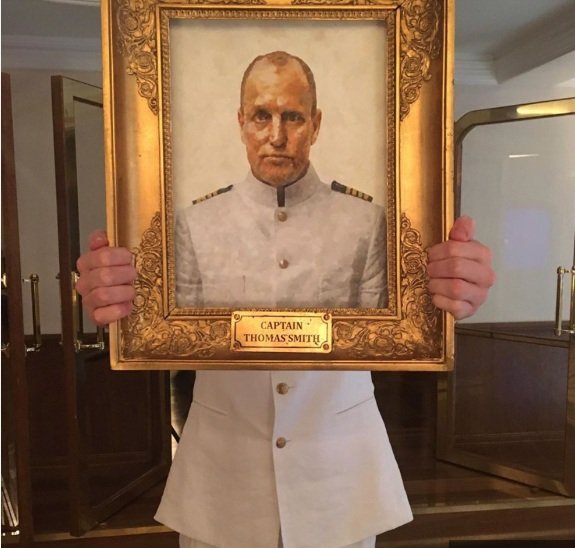
TRIANGLE OF SADNESS (2022)
2022 sardonic comedy

Ruben Östlund’s caustic satireTriangle of Sadness takes a wrecking ball to the excesses of wealth, privilege, and social hierarchies. Split into three acts, the film moves from the sterile artifice of the fashion industry to the grotesque opulence of a luxury cruise and finally lands in the chaos of survival, where the power dynamics flip entirely.

File Under: Satire, Social Commentary, Modern Dark Comedy, Class Critique.
Östlund, fresh from his success with Force Majeure, turns his lens to despicable characters representative of the worst of capitalism: vapid influencers, bored billionaires, and inept authority figures. Among them is Carl (Harris Dickinson), a male model grappling with his fragile ego, and Yaya (Charlbi Dean), his influencer girlfriend, in a deeply transactional relationship. Their luxury cruise—captained by an alcoholic and unhinged Marxist drunkard (played by the brilliant Woody Harrelson)—descends into chaos. Vomit fountains, dysfunction, and primal absurdity reveal that, when stripped of wealth and privilege, humanity’s most grotesque instincts emerge.
The cinematography embraces clean, hyper-realistic frames that accentuate the emptiness of wealth. The score crescendos to add a perverse sense of beauty to the film’s most unsettling moments. Östlund builds tension by letting his camera linger, allowing discomfort to marinate into black humor.
Awarded the 2022 Palme d’Or at Cannes, Triangle of Sadness’s blunt-force satire struck a nerve, with critics debating whether it skewers capitalism effectively or simply revels in its own shock value. But that seems to be precisely Östlund’s point: there’s no clean moral takeaway here.
A perfect counter-programming for those tired of the saccharine Triangle of Sadness is Ruben Östlund having fun with a cinematic shipwreck you can’t ignore.
"Triangle of Sadness", Ruben Östlund. 2022, Sweden-France.
Running Time: 147 Minutes. English-Swedish.
Available for rent on Amazon Prime Video, Apple TV, and Vudu.


THROW AWAY YOUR BOOKS, RALLY IN THE STREETS
1971 Japanese experimental meditation


Shuji Terayama’s avant-garde film critiques American & Japanese materialism through the narrative of a poor young man trying to make himself a life in a capitalist society with a dysfunctional family. The imagery is psychedelic/ surreal, soundtrack is punk singalong, the cinematography experimental, a script chock full of symbolism and social commentary. Teryama in 1971, a master at work.


Matias Faldbakken
creative vandalism
This week’s art post features the work of Matias Faldbakken. Faldbakken’s sculptures/ combines have an absurdity to them, a dark comic theatricality and resonant gestalt. He is represented by Standard Oslo. In addition to his visual art he has written several novels and a collection of short stories.


“Faldbakken... (has an) ability to bite his own tail by making works that unite vandalism and creativity, while both celebrating and lamenting the constant commodification of rebellious acts.
More than anyone, he understands that frontal critique only reinforces the classic master-slave dialectic, and that true radicality consists of infiltrating and perverting the system from within. ”

Photo credits:
Simon Lee Gallery, London, Hong Kong
Occula, Gallery Chant Grousel, Paris
Renaissance Society, “Fear of Property” Installation, University of Chicago
Mousse Magazine, Museum Boijmans, Rotterdam
kunstkritikk, Nordic Art Review, Astrup Fearnley Museum of Modern Art, Oslo